
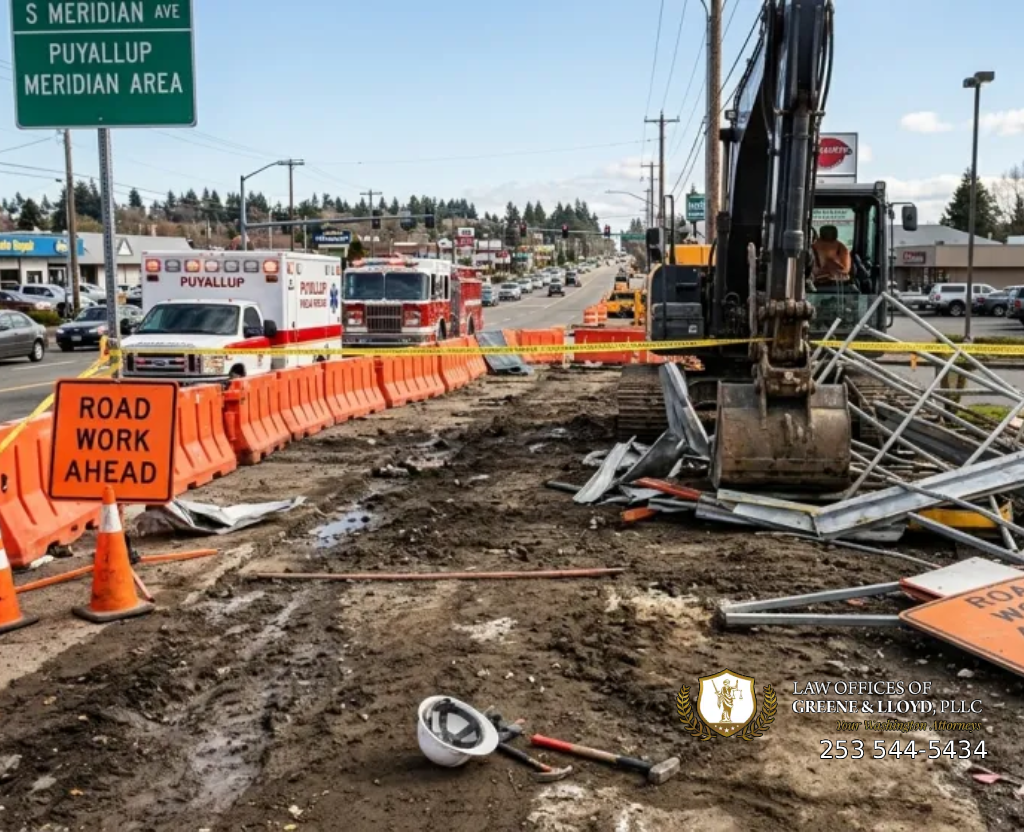
Falls, equipment failures, and jobsite hazards leave workers with serious injuries. We pursue every source of recovery beyond a standard workers’ comp claim.
Practice Area — Construction Injuries
Construction Accident Attorney
Hurt on a Puyallup construction site? L&I workers' comp may not be your only option. Many injured workers don't realize that when someone other than their employer contributed to the accident, a separate civil claim can exist alongside their L&I benefits. Attorneys Rob Lloyd and Tim Greene look for those third-party claims — and the fuller compensation they can bring. Free, confidential, available 24/7.
Serving Puyallup, South Hill & all of Pierce County · Free consultation available 24/7
L&I + moreThird-party claims beyond workers' compTitle 51 RCW
3 yrsTo file a third-party lawsuitRCW 4.16.080
No feeUnless we recover for youContingency representation
The Key QuestionL&I Isn't Always Your Only Option
If you were hurt on the job, your first — and often only — thought is workers' compensation through Washington's Department of Labor & Industries. L&I matters, and you should file. But it's rarely the whole story on a construction site, where several different companies work side by side.
The distinction that changes everything
Under Washington's Industrial Insurance Act (Title 51 RCW), you generally can't sue your own employer — L&I is the trade-off for that. But when a third party — a general contractor, a different subcontractor, a property owner, or the manufacturer of defective equipment — contributed to your injury, you may have a separate civil claim against them, in addition to your L&I benefits. That's where the compensation L&I doesn't pay, like full lost wages and pain and suffering, can come from.
On a busy site, multiple employers, subs, and suppliers are usually present — which is exactly why a construction injury so often involves a responsible third party that a worker never thinks to look for.
L&I vs. Third-PartyWhat Each Claim Covers
The two claims do different jobs, and having both is often what makes an injured worker whole:
- Your L&I claim provides medical coverage and a portion of lost wages, regardless of fault — but it does not pay for pain and suffering, and it replaces only part of your income.
- A third-party claim can recover the rest: full lost earnings and earning capacity, pain and suffering, and other damages a negligent third party caused.
You don't have to choose one over the other. In many cases you receive L&I benefits and pursue a third-party claim at the same time. L&I may assert a right to be repaid out of a third-party recovery, and coordinating that the right way is one of the most valuable things an attorney does on these cases — done well, it can leave you meaningfully better off than L&I alone.
Common CausesHow Construction Injuries Happen — and Who May Be Liable
The injuries we see on Puyallup-area sites commonly arise from:
- Falls from scaffolding, ladders, roofs, and unprotected edges.
- Struck-by incidents — falling tools or materials, or moving equipment and vehicles.
- Caught-in or crushing injuries involving machinery, trenches, or collapses.
- Electrocutions and contact with power sources.
- Defective or poorly maintained equipment and tools.
Each of those points toward a possible third party: a scaffolding company, an equipment manufacturer, a site's general contractor responsible for safety, another subcontractor, or a property owner. Identifying who — beyond your employer — created the hazard is the heart of the case.
Right AwayWhat to Do After a Construction Site Injury
What you do early protects both your L&I claim and any third-party claim:
- Report the injury to your employer and get medical care promptly — many injured workers in this area are treated at MultiCare Good Samaritan.
- File your L&I claim. It has its own separate, shorter reporting deadlines, so don't delay.
- Document the scene — photos of what caused the injury, the equipment involved, and the companies working on site.
- Get witness information from coworkers and other trades before people move to different job sites.
- Talk to an attorney before giving any recorded statement, so a potential third-party claim isn't lost.
Washington LawDeadlines & Shared Fault
Two different clocks
Your L&I claim has its own, shorter reporting deadlines. A separate third-party lawsuit generally must be filed within three years of the injury (RCW 4.16.080). Because evidence on an active job site changes fast — crews rotate, equipment is moved — acting early matters even more here than in an ordinary injury case.
Partial fault doesn't bar recovery
On a third-party claim, Washington's pure comparative fault rule (RCW 4.22.005) means you can still recover even if you were partly at fault — your recovery is reduced by your share, not eliminated.
We handle third-party construction injury claims on a contingency-fee basis — no attorney fee upfront, a fee only if we recover for you. You work directly with Rob Lloyd and Tim Greene.
This page provides general information about Washington law and is not legal advice. Whether a third-party claim exists, and which deadlines apply, depends on the specific facts of your case; contact us to discuss your situation.
Common Questions
Construction Injury Claim FAQ
Can I sue if I was hurt on a construction site in Washington?
Usually you can't sue your own employer, because Washington's L&I workers' compensation system is generally the exclusive remedy against an employer. But if a third party — someone other than your employer, such as a subcontractor, equipment manufacturer, or property owner — contributed to your injury, you may have a separate civil claim in addition to your L&I benefits.
What is a third-party construction injury claim?
It's a civil claim against someone other than your employer whose negligence contributed to your injury — for example, a general contractor, a subcontractor, a property owner, or the maker of defective equipment. Unlike an L&I claim, a third-party claim can include compensation for pain and suffering and full lost earnings.
Can I file an L&I claim and a lawsuit at the same time?
In many cases, yes. You can receive L&I workers' compensation benefits and also pursue a third-party civil claim when someone other than your employer is responsible. L&I may assert a right to be repaid from a third-party recovery, which is one of the things an attorney helps you manage.
How long do I have to file a construction injury lawsuit in Washington?
A third-party personal injury lawsuit generally must be filed within three years of the injury (RCW 4.16.080). Your L&I claim has its own separate, shorter reporting deadlines, so it's important to act promptly on both fronts.
What if I was partly at fault for the construction accident?
You can still recover on a third-party claim. Washington follows a pure comparative fault rule (RCW 4.22.005), so your recovery is reduced by your percentage of fault rather than eliminated.
How much does a construction accident attorney cost?
We handle third-party construction injury claims on a contingency-fee basis. You pay no upfront attorney fee, and a fee is owed only if we recover compensation for you. Your initial consultation is free.
Talk to a Puyallup Construction Accident Attorney
L&I may not be your only claim. Let's find out.
If someone other than your employer contributed to your injury, you may be entitled to more than workers' comp alone. Greene & Lloyd is ready to help — your case review is free, confidential, and available 24/7.
The Law Offices of Greene & Lloyd, PLLC
4115 S Meridian Ste B, Puyallup, WA 98373(253) 544-5434 · Free consultation 24/7
Serving
Puyallup · South Hill · TacomaAll of Pierce County, Washington
The information on this page is provided for general informational purposes only and does not constitute legal advice, nor does it create an attorney-client relationship. Statutory references describe general Washington law and may not reflect the specific facts or deadlines of your situation. Consult a licensed Washington attorney about your individual case. Prior results do not guarantee a similar outcome.
