Practice Area — Premises Liability
Unsafe Property Conditions Claims
Injured by a broken stair, defective railing, inadequate lighting, or another hazard on someone else's property in Puyallup? Property owners have a legal duty to maintain safe conditions — and when they don't, they can be held responsible. Attorneys Rob Lloyd and Tim Greene represent injury victims across the full range of premises liability claims in Pierce County. Free, confidential, available 24/7.
Serving Puyallup, South Hill & all of Pierce County · Free consultation available 24/7
KnowledgeOwner knew or should have knownWA premises liability standard
3 yrsGeneral Washington deadlineRCW 4.16.080
No feeUnless we recover for youContingency representation
What the Law RequiresThe Property Owner's Duty and What Breaks It
Washington premises liability law requires property owners to maintain their property in a reasonably safe condition for people who have a right to be there. The central legal standard is whether the owner knew or should have known about a dangerous condition and failed to fix it or adequately warn about it.
Constructive knowledge — "should have known" matters
Actual knowledge isn't always required. A property owner "should have known" about a hazard when a reasonable inspection would have revealed it. A broken stair that had been deteriorating for months, a railing that had been reported as loose, or a light fixture that had been out for weeks all put the owner on constructive notice — even if they claim they didn't personally know. That's a core argument in many premises liability cases.
Common unsafe conditions that support claims in the Puyallup area include:
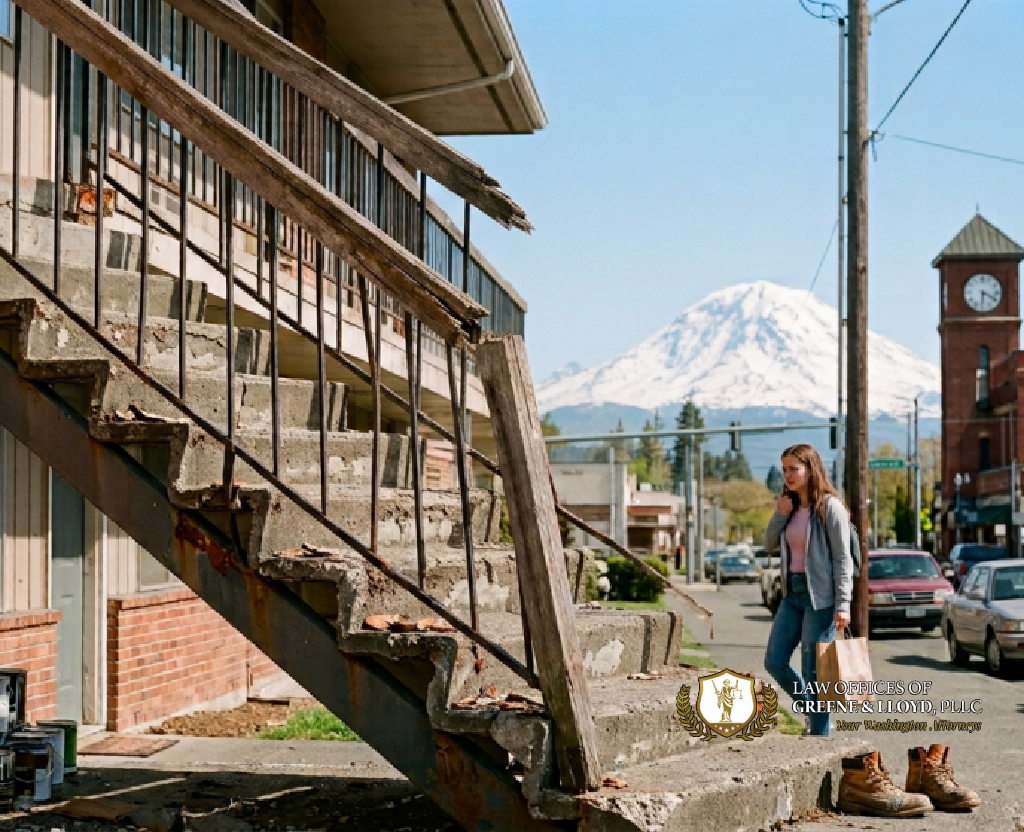
- Broken or deteriorating stairs and steps — in apartment buildings, commercial properties, and retail spaces along the Meridian Ave corridor.
- Defective or missing handrails and guardrails on stairs, balconies, and elevated walkways.
- Unguarded openings, drop-offs, and elevated platforms in commercial and industrial settings.
- Inadequate lighting in parking lots, stairwells, and building entryways — a particular issue in Puyallup's wet, dark fall and winter months.
- Deteriorating walkways and parking surfaces with potholes, cracks, and uneven surfaces the owner knew about but didn't repair.
- Structural hazards — collapsing decks, unsecured shelving, ceiling failures.
- Swimming pools and water hazards without adequate barriers or signage.
This page provides general information about Washington law and is not legal advice. The rules that apply depend on the specific facts of your situation; contact us to discuss your case.
Right AwaySteps to Take After an Unsafe Property Injury
- Get medical care immediately. Many premises liability injuries in the South Hill area are treated at MultiCare Good Samaritan. The medical record establishes the timing and nature of the injury.
- Report the incident to the property owner or manager before leaving and request a copy of the written incident report.
- Photograph the hazard thoroughly — before it's repaired, cleaned up, or altered. The condition of the property at the time of injury is what matters, and owners often move quickly to fix hazards after an incident.
- Get witness information — anyone who saw the condition or the incident.
- Preserve evidence of prior complaints. If you or others reported the hazard before your injury, note who you reported it to and when — that prior notice strengthens the "knew or should have known" element significantly.
- Contact an attorney before giving any statement to the property's insurer — and especially before signing anything.
Government PropertyThe Notice Trap That Can Bar a Valid Claim
This procedural requirement stops more valid claims than almost any other single issue in premises liability law — and it applies specifically when the unsafe condition was on public property.
City sidewalk, public park, municipal building? A notice step is required first.
Before filing a lawsuit against a local government entity in Washington — a city, county, or public agency that owns or maintains a property — a formal tort claim notice must be presented to that entity (RCW 4.96.020). The entity then has a mandatory waiting period to respond. Missing this step can permanently bar the claim — even within the general three-year deadline. Private property follows standard negligence litigation with no such pre-suit requirement.
Common government-property situations where this applies: trips on uneven public sidewalks in South Hill, injuries in city parks, incidents in public buildings or municipal facilities, and hazards on publicly maintained pathways. Identifying who owns and maintains the property — and whether the notice step applies — is one of the first things we establish in any premises liability case.
Washington LawDeadlines, Constructive Fault & Comparative Fault
Three years — with an earlier effective clock on government property
Washington's general personal injury deadline is three years from the date of injury (RCW 4.16.080). Government property claims have the pre-suit notice requirement that creates an earlier effective deadline. Surveillance footage and property records have much shorter retention windows than either legal deadline — evidence urgency typically precedes the legal deadline by months.
Partial fault doesn't end your claim
Washington's pure comparative fault rule (RCW 4.22.005) applies to premises liability claims. Not watching where you were walking, wearing inappropriate footwear, or being momentarily distracted may reduce your recovery by your share of fault — but it doesn't eliminate a valid claim against a property owner whose hazardous condition caused the injury. Property owners and their insurers routinely overstate a claimant's contributory fault.
We handle unsafe property conditions claims on a contingency-fee basis — no attorney fee upfront, a fee only if we recover for you. You work directly with Rob Lloyd and Tim Greene throughout.
Be HonestWhen You May Not Need a Premises Liability Attorney
We'll tell you plainly. A minor incident with no significant injury, no lasting impact, no medical bills, and a hazard so obvious and brief that no reasonable owner could have anticipated the risk likely doesn't support a legal claim — and we'll say so rather than take a case that isn't viable.
It becomes a legal matter when there's a meaningful injury, documented medical costs or lost wages, a hazard the owner clearly knew about or should have known about, or — especially — when the property is owned by a government entity where the notice step creates immediate urgency. A free consultation takes that uncertainty off the table.
Common Questions
Unsafe Property Conditions FAQ
What qualifies as an unsafe property condition in Washington?
An unsafe property condition is a hazard on someone else's property that the owner knew or should have known about and failed to fix or warn about — including broken stairs, inadequate lighting, unguarded openings, defective railings, deteriorating walkways, structural hazards, and similar conditions. The requirement is that the owner had actual or constructive knowledge of the hazard and failed to act.
Does it matter what type of property visitor I was when I was injured?
Washington has largely moved to a general negligence standard for premises liability rather than strictly distinguishing between invitee, licensee, and trespasser categories. The primary question is whether the property owner acted reasonably under the circumstances — though the nature of the visitor relationship can still be relevant. A free consultation clarifies how the facts of your situation apply.
How long do I have to file an unsafe property conditions claim in Washington?
Three years from the date of injury under Washington's general personal injury statute of limitations (RCW 4.16.080). If the property is owned by a government entity, a tort claim notice must be filed before suit (RCW 4.96.020), adding a procedural step with its own timeline. Evidence like surveillance footage can disappear within days.
Can I recover if I was partly responsible for my injury on unsafe property?
Yes. Washington follows a pure comparative fault rule (RCW 4.22.005). Being partly at fault reduces your recovery by your percentage rather than eliminating it. Property owners and their insurers often try to overstate a claimant's contributory fault.
What if the property owner says they didn't know about the hazard?
Actual knowledge isn't always required. Washington premises liability also applies when a property owner should have known about a hazard — constructive knowledge. A broken step that had been deteriorating for months may support a claim even if the owner claims ignorance, because a reasonable inspection would have revealed it.
How are unsafe property conditions attorney fees structured?
On a contingency-fee basis. You pay no upfront attorney fee, and a fee is owed only if we recover compensation for you. Your initial consultation is free.
Talk to a Puyallup Premises Liability Attorney
A hazard the owner knew about is a hazard they're responsible for.
If an unsafe condition on someone else's property caused your injury in Puyallup, Greene & Lloyd can assess the claim, identify every liable party, and handle the procedural steps — including the government-notice requirement if it applies. Your case review is free, confidential, and available 24/7.
The Law Offices of Greene & Lloyd, PLLC
4115 S Meridian Ste B, Puyallup, WA 98373(253) 544-5434 · Free consultation 24/7
Serving
Puyallup · South Hill · TacomaAll of Pierce County, Washington
The information on this page is provided for general informational purposes only and does not constitute legal advice, nor does it create an attorney-client relationship. Statutory references describe general Washington law and may not reflect the specific facts or deadlines of your situation. Consult a licensed Washington attorney about your individual case. Prior results do not guarantee a similar outcome.
