
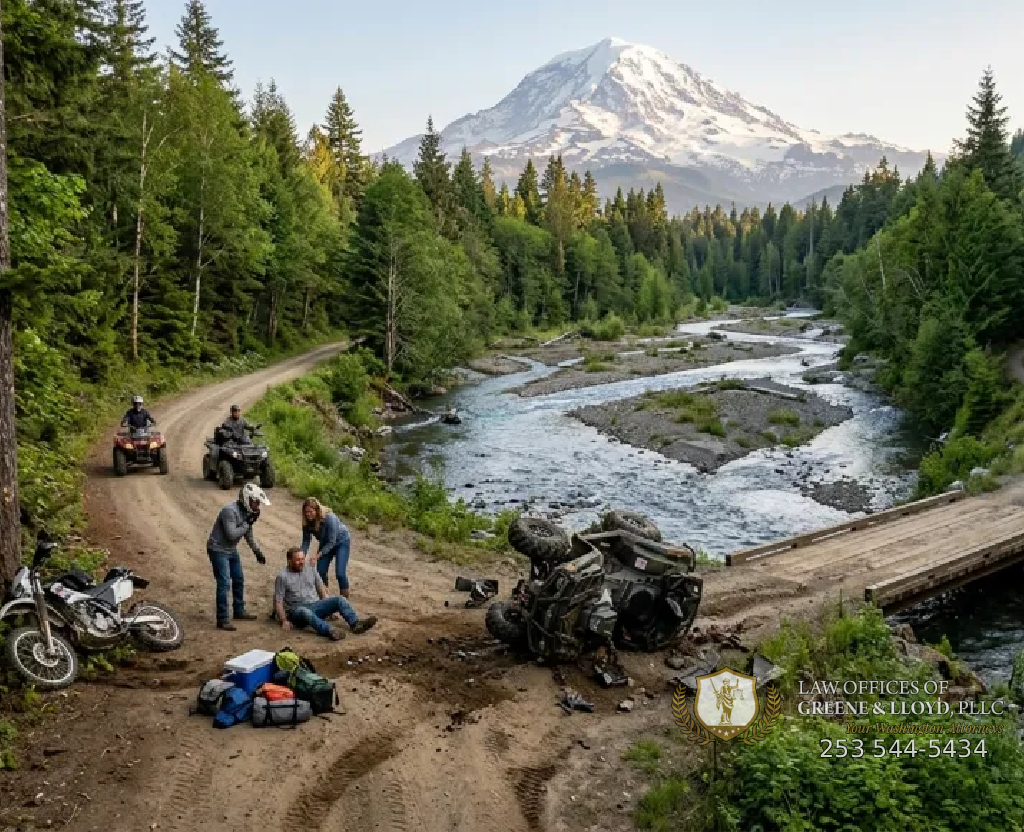
Practice Area — Recreational Vehicle Accidents
Recreational Vehicle Accident Claims
Hurt in an ATV, dirt bike, RV, golf cart, or other recreational vehicle crash near Puyallup? Even a single-vehicle crash may have a liable third party. Recreational vehicle accidents involve a different set of laws, insurance policies, and liability questions than ordinary car crashes. Attorneys Rob Lloyd and Tim Greene identify who is responsible and pursue full compensation. Free, confidential, available 24/7.
Serving Puyallup, South Hill & all of Pierce County · Free consultation available 24/7
3 yrsTo file in WashingtonRCW 4.16.080
ORVOff-road vehicle rules applyRCW 46.09
No feeUnless we recover for youContingency representation
Vehicle TypesWhat Counts as a Recreational Vehicle Accident Claim
Recreational vehicle accident claims cover a wide range of vehicles and settings — each with its own applicable laws and insurance considerations:
- ATVs and off-road vehicles (ORVs/OHVs) — rollovers, collisions, and crashes on trails, private land, or during events. Washington's off-road vehicle statutes (RCW 46.09) govern operation, registration, and equipment requirements for these vehicles.
- Dirt bikes and motocross motorcycles — crashes at tracks, on trails, or on roads where the bike may or may not be street-legal.
- RVs, motorhomes, and camper vans — on-road accidents that follow standard vehicle liability rules, but with the added complexity of a larger vehicle and potentially a rental or shared-ownership situation.
- Golf carts and low-speed vehicles — collisions on golf courses, in retirement communities, or on shared paths and roadways where they're permitted.
- Snowmobiles — crashes on designated trails or private land in the mountain areas accessible from Pierce County.
- Boats and personal watercraft — collisions, wake injuries, and operator negligence on area waterways.
The Key QuestionSingle-Vehicle Crash Doesn't Mean No One Else Is Responsible
This is the insight most people don't know to ask about — and it's where recreational vehicle claims most often have more legal options than they first appear.
Three sources of third-party liability in a "solo" crash
Product defect. If the ATV, dirt bike, or other vehicle had a design flaw, manufacturing defect, or inadequate safety feature that contributed to the crash, the manufacturer may be liable under Washington's Product Liability Act (RCW 7.72) — even if no other vehicle was involved.
Property or trail condition
Property owner or land manager. A dangerous trail condition, an unmarked hazard, inadequate fencing or signage on private land or a managed recreational area can make the property owner or managing entity responsible for a crash that appears to be single-vehicle. This applies to both private landowners and government-managed recreational areas — noting that government claims require a notice of claim step.
Operator or owner liability
Vehicle owner or third-party operator. If you were a passenger or bystander hurt by someone else's negligent operation of a recreational vehicle, that operator — and potentially the vehicle's owner — may be liable. Owner liability can also attach when an owner knowingly entrusts a vehicle to an incompetent or inexperienced operator.
InsuranceRecreational Vehicles and the Coverage Gap
One of the most common problems in recreational vehicle claims is discovering that the vehicle wasn't covered by any applicable insurance — or that the coverage is far smaller than expected.
- Standard auto policies usually don't cover off-road vehicles. An ATV, dirt bike, or snowmobile used off-road is typically excluded from a homeowner's or standard auto policy — a separate recreational vehicle policy or rider is needed, and many people don't have one.
- Homeowners policies sometimes provide limited coverage for recreational vehicles on the insured property — but that coverage rarely extends off-premises.
- Rental vehicle situations add another layer: whose insurance applies — the renter's, the rental company's, or a credit card's travel protection — depends on the specific facts and agreements.
- Event and track insurance may cover participants at organized events or motocross tracks, and that coverage should be identified and examined.
Identifying every applicable policy — including uninsured motorist coverage where relevant — is one of the first and most important things we do on a recreational vehicle claim.
Right AwaySteps to Take After a Recreational Vehicle Accident
- Get medical care immediately. Recreational vehicle crashes often cause serious orthopedic, spinal, and head injuries. Many Pierce County residents go to MultiCare Good Samaritan in Puyallup — go there even if you feel okay at the scene, since adrenaline masks pain.
- Preserve the vehicle. Don't repair or return the vehicle before it can be inspected. If a defect caused the crash, the vehicle itself is the primary evidence — and it can be lost permanently if repaired, returned, or disposed of.
- Document the scene. Photos of the vehicle, the crash site, any trail or road hazard, the conditions, and your injuries before anything is moved or changed.
- Identify all parties and insurance. The owner, the operator, and the vehicle's registration and insurance information — recreational vehicle ownership is sometimes informal, which makes this step more complicated than a standard car crash.
- Contact an attorney before you talk to any insurer — including the vehicle owner's or operator's insurance company.
Washington LawComparative Fault, the Deadline & Equipment Rules
Partial fault doesn't bar recovery
Washington's pure comparative fault rule (RCW 4.22.005) applies to recreational vehicle claims. Not wearing required safety equipment, riding in a prohibited area, or being partly responsible for a crash reduces your recovery by your share of fault — but does not eliminate your claim entirely.
Three-year deadline — but preserve the vehicle first
Washington's general personal injury deadline is three years from the date of injury (RCW 4.16.080). The practical urgency for recreational vehicle claims is preserving the vehicle before it's repaired or scrapped — that window can be days, not years.
We handle recreational vehicle accident claims on a contingency-fee basis — no attorney fee upfront, a fee only if we recover for you. You work directly with Rob Lloyd and Tim Greene throughout.
This page provides general information about Washington law and is not legal advice. The specific rules, equipment requirements, and deadlines that apply depend on the vehicle type, location, and facts of your situation; contact us to discuss your case.
Common Questions
Recreational Vehicle Accident FAQ
What types of recreational vehicle accidents lead to injury claims?
Claims commonly arise from ATV and off-road vehicle rollovers or collisions, dirt bike and motocross crashes, RV and motorhome accidents on public roads, golf cart collisions, snowmobile crashes, and boat and watercraft accidents. The vehicle type determines which laws apply and which insurance policies may cover the claim.
Can I make a claim if I was hurt on someone else's ATV?
Possibly. When you're injured while riding someone else's ATV or recreational vehicle, the owner's liability may extend to your injuries if the owner entrusted the vehicle to an inexperienced or incompetent operator, or if the vehicle had a known defect. A free consultation helps assess the specific facts.
What if it was a single-vehicle crash with no other driver involved?
A single-vehicle crash doesn't necessarily mean no one else is responsible. A product defect in the vehicle or its components, a dangerous road or trail condition created by a property owner, or an operator who was inexperienced or impaired can all create liability even without a second vehicle. We evaluate every potential source of responsibility.
How long do I have to file a recreational vehicle accident claim in Washington?
Washington's general personal injury statute of limitations is three years from the date of injury (RCW 4.16.080). If a government entity was responsible for a hazard, a notice of claim may be required before suit. Speak with an attorney promptly — and preserve the vehicle before it's repaired.
Does Washington require helmets for ATV and off-road vehicle riders?
Washington's off-road vehicle statutes (RCW 46.09) include equipment and safety requirements for ORVs. The specific requirements vary by vehicle type and location. If you were not wearing required safety equipment, it may be raised as a comparative fault issue — though it doesn't automatically bar a claim.
How are recreational vehicle accident attorney fees structured?
On a contingency-fee basis. You pay no upfront attorney fee, and a fee is owed only if we recover compensation for you. Your initial consultation is free.
Talk to a Puyallup Recreational Vehicle Accident Attorney
Even a solo crash may have a liable third party. Let's find out.
Recreational vehicle accidents raise questions that ordinary car crash claims don't. Greene & Lloyd identifies every source of liability and coverage. Your case review is free, confidential, and available 24/7.
The Law Offices of Greene & Lloyd, PLLC
4115 S Meridian Ste B, Puyallup, WA 98373(253) 544-5434 · Free consultation 24/7
Serving
Puyallup · South Hill · TacomaAll of Pierce County, Washington
The information on this page is provided for general informational purposes only and does not constitute legal advice, nor does it create an attorney-client relationship. Statutory references describe general Washington law and may not reflect the specific facts, vehicle types, or deadlines of your situation. Consult a licensed Washington attorney about your individual case. Prior results do not guarantee a similar outcome.
